
~10 min read
Introducing Alien
“When we no longer know who or what to trust, we are all alien until proven human.”
AI-generated content is creating an information apocalypse that threatens to overwhelm authentic human voices online. As synthetic content spreads and AI agents multiply, distinguishing people from machines becomes increasingly vital. In this new terrain, decentralized identity is not just an ideal, it’s a necessity: a way to assert humanness without ceding control to centralized platforms or opaque AI systems, to center our information networks around authentic human experience. This is particularly important in a world where authoritarian politics and digital technocracy threaten to deepen existing inequalities and suppress dissent, compounded by AI companies amassing personal data at an unprecedented scale. With this in mind, we need digital systems where personhood can be verified without being surveilled, where communities can establish trust without relying on centralized institutions, and where cryptography protects not just what we transact but who we are.
Introducing Alien
Alien is focused on building digital trust in the age of AI. We are creating fair and credibly neutral identity infrastructure through the Alien Network, a decentralized system that enables people to verify their unique humanity and identity without sacrificing privacy or agency. As digital systems become increasingly centralized, we’re committed to ensuring that humans remain sovereign and free on the internet. The Alien Network has been built with three key components — Alien ID, Continuous Human Verification Protocol and Aliencoin — all accessible via the Alien App.
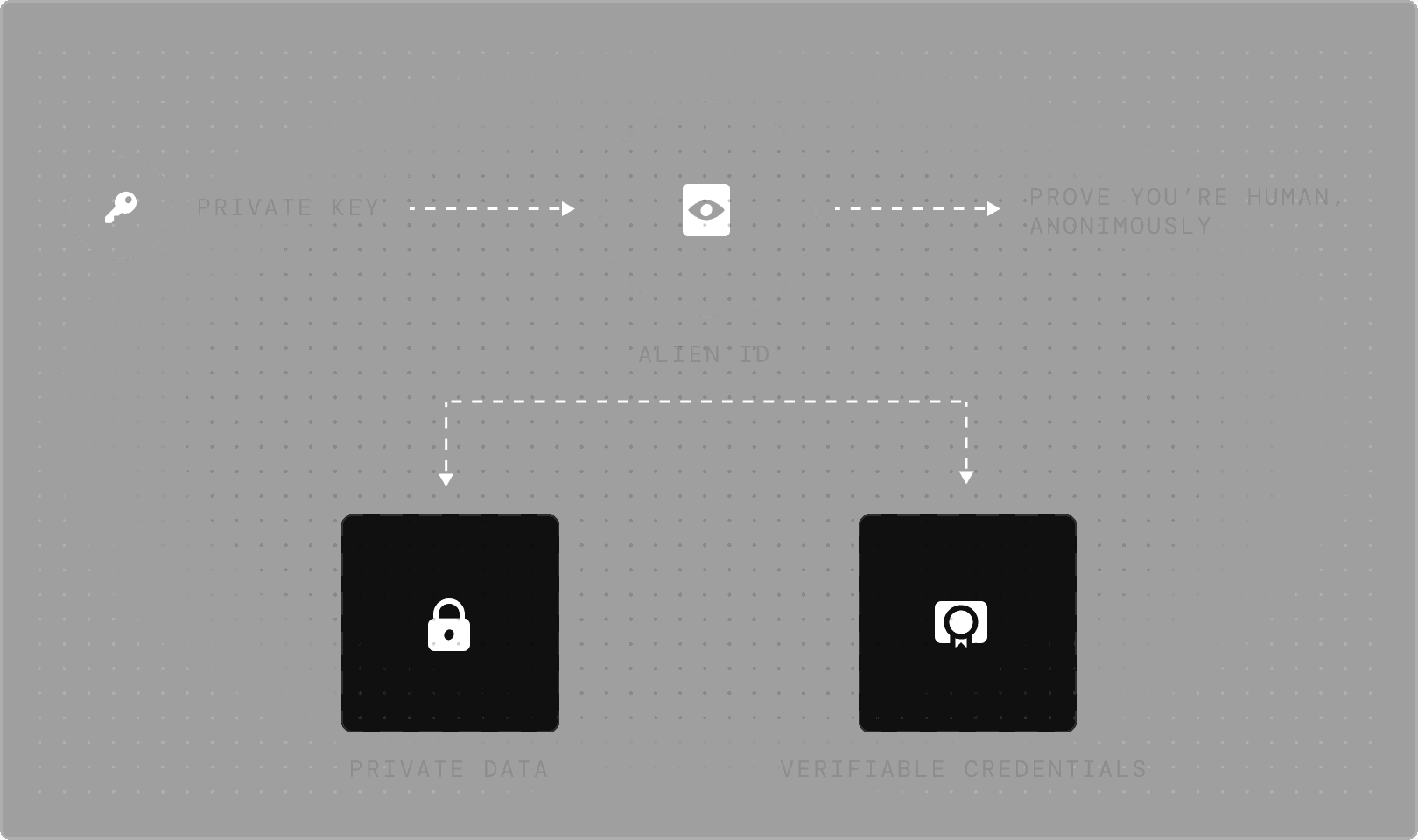
Alien Network
The Alien Network is a programmable, decentralized, highly-scalable L1 blockchain that is built as a public good, which means it’s entirely owned by its users. Unlike traditional systems where identification equates to surrendering privacy, Alien approaches verification as recognition: users acknowledge one another's humanity while maintaining control over their identity. This recognition-based approach directly addresses the "Proof of Personhood" (PoP) problem.
In digital systems, PoP is a way of preventing Sybil attacks that lead to disproportionate influence or rewards. Attempts to solve this challenge have consistently created new problems: centralized biometric systems raise privacy concerns and present attractive targets for hackers; social graphs can be gamed through fake profiles; and economic barriers favor those with money to circumvent them. Previous approaches have focused on making systematic attacks expensive without addressing the structural issues that enable deception. What's needed is not just protection, but a system where honest participation remains accessible and deception becomes exponentially more costly. The Alien Network meets this need with an architecture for self-sovereign verification, which is enacted through the Alien ID.
Alien ID
We believe that a resilient digital identity requires five interdependent primitives:
Proof of Humanness.
Proof of Uniqueness.
Proof of Ownership.
Proof of Identity.
Proof of Sub-identity.
Together, these primitives address the critical vulnerabilities in digital systems: the first distinguishes people from bots or AI; the second and third establish individual identity and uniqueness, preventing one person from creating multiple accounts; the fourth prevents hacking and impersonation; and the fifth enables users to maintain verified identities across different contexts, including the ability to authorize AI agents to act on their behalf.
The Alien ID recognizes that verification methods often fail when used in isolation or within centralized systems, which reflects the view that common verification methods are effective when combined and decentralized. This is realized by the Continuous Human Verification Protocol (CHVP), which integrates biometrics, decentralized oracles and social graphs in a way that addresses their individual vulnerabilities. It also anticipates a likely future where verifying human users evolves from a binary yes or no — like a captcha — to a probabilistic confidence score.
Continuous Human Verification Protocol
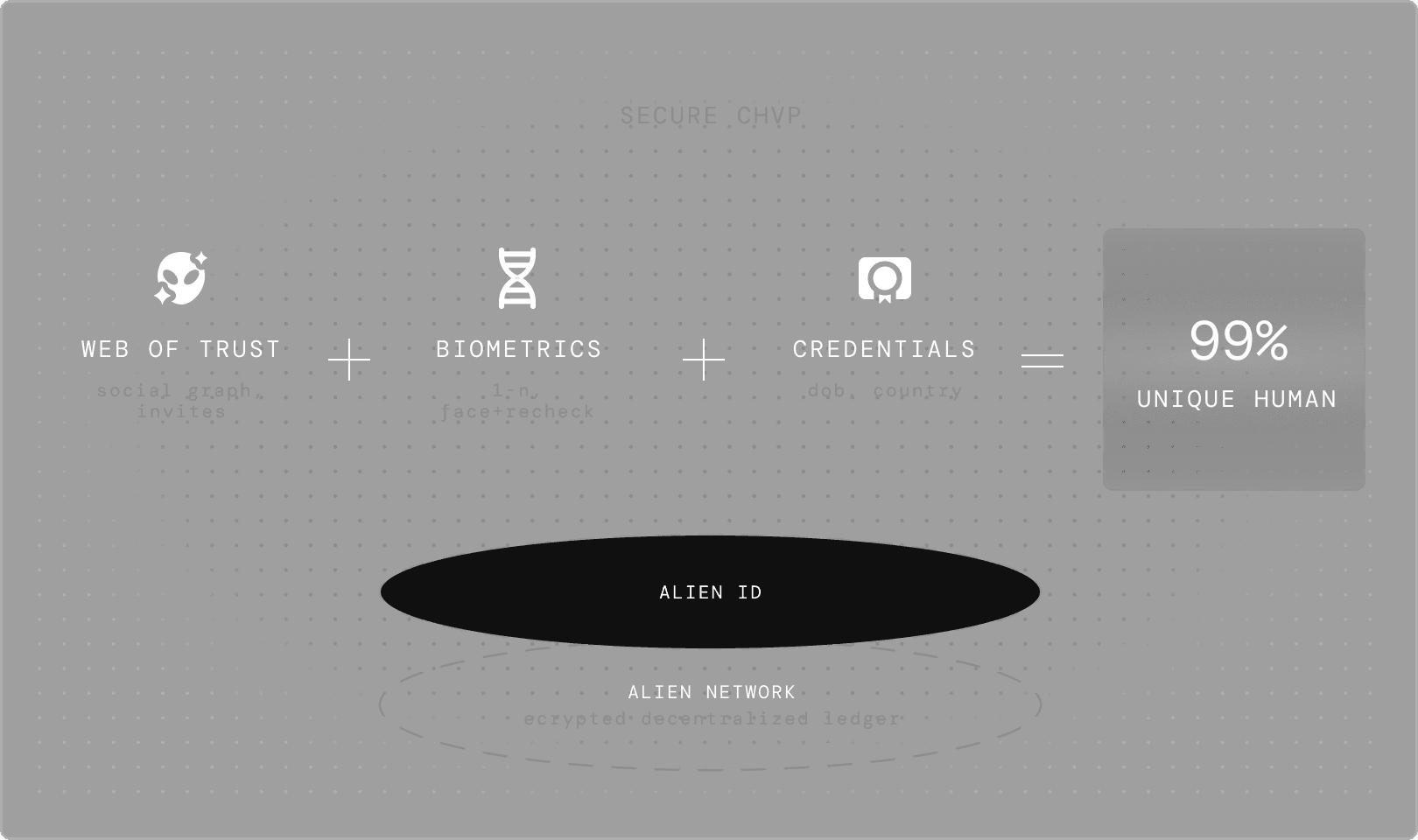
The CHVP is the core innovation of the Alien team. Centered on the principle of one digital identity per human, it’s an open-source verification standard that establishes the minimum number of verification steps that make fraud exponentially more difficult. It integrates three verification events into a single chain: face biometry verifies a living human is present while creating a unique key; notarized credentials confirm identity through an immutable fact (date of birth); and a social graph is created with authentic human relationships that are difficult to fabricate. The protocol will maintain ongoing verification through periodic checks, while also allowing third-party developers to add additional verification steps if needed.
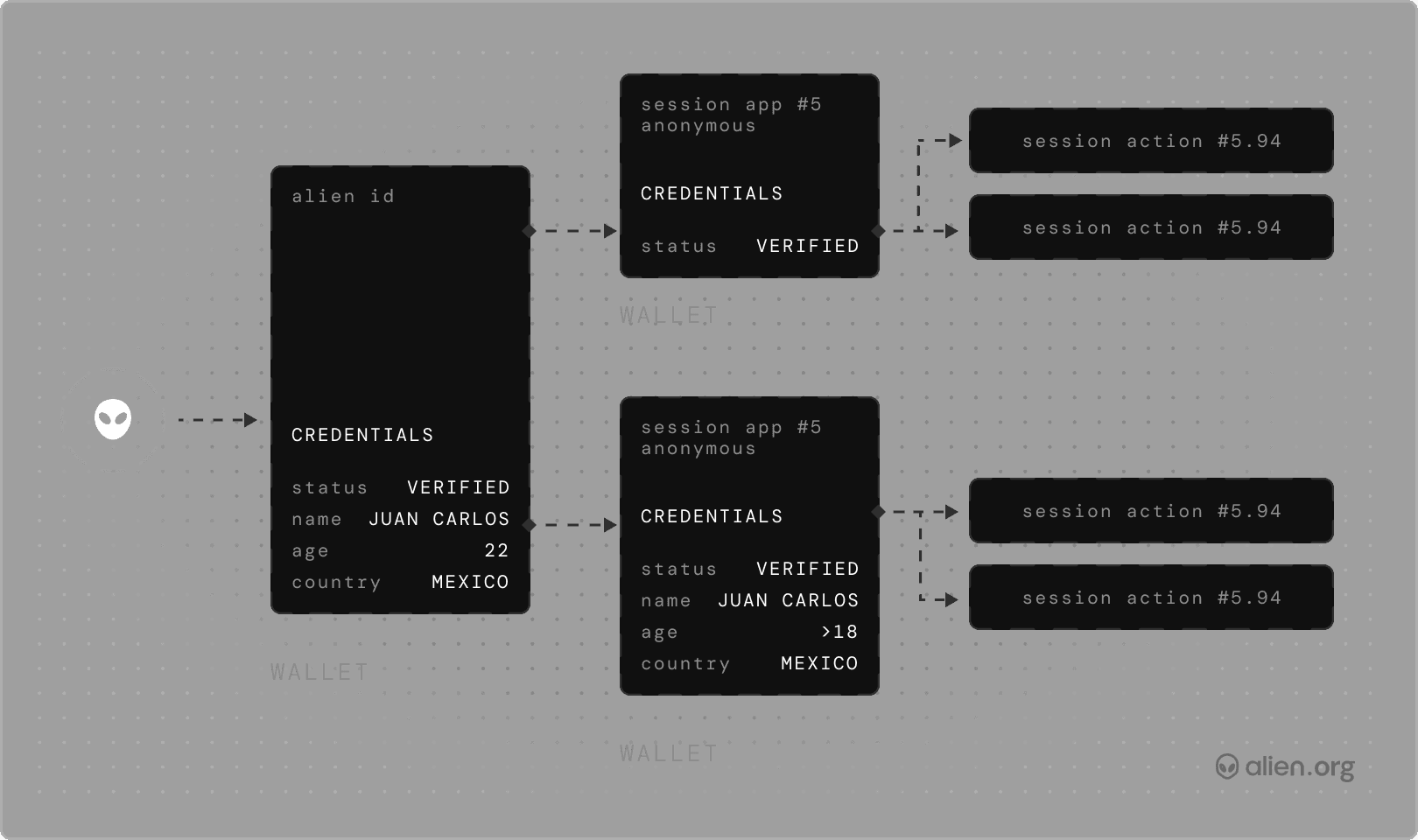
Personal data remains under user control — stored where and how they choose — while cryptographic proofs are recorded on-chain and linked to each Alien ID. Users alone decide when and with whom to share their information. This creates a framework where individuals have complete control over their identity attributes, enabling secure management of their identity across different contexts and platforms (through cryptographically derived sub-identities called Sessions).
Privacy
Establishing an identity infrastructure like the Alien Network creates a comprehensive surveillance tool: a single identifier linked to all of your actions and interactions, which can track and control your online existence. Thus privacy is crucial to guarantee digital trust. Current privacy models require users to trust platforms with their data yet provide no technical mechanisms to enforce or verify that trust. For true privacy to exist, it must be cryptographically verifiable; violations must be technically impossible; and users must maintain sovereignty over their data.
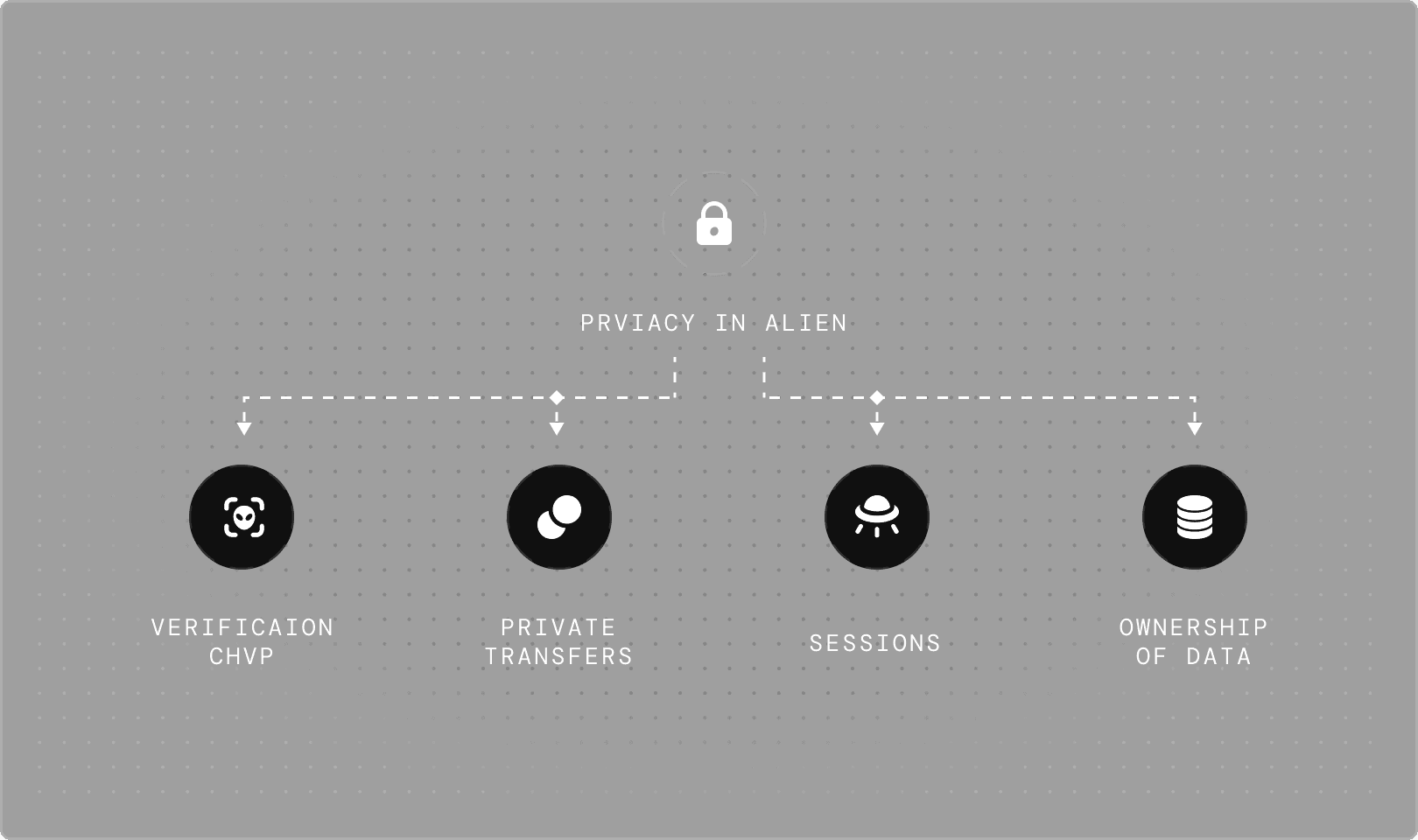
Alien addresses this through technical design. The CHVP requests only necessary information that it doesn’t store, creating cryptographic confirmations like hashes and merkle roots rather than raw personal data. The network’s infrastructure — designed specifically for Alien, which we’ve named Frame — ensures that computations occur within TEEs, and data remains shielded from access or modification, even by hardware owners. This creates verifiable and mathematically guaranteed privacy that enables what we call self-sovereign personal profiles: users can interact online while maintaining cryptographic control over their data, identity and privacy. Consequently, the Alien ID reveals nothing about users except that they are verified unique humans.
This principle extends to transfers on the network. The Alien Network supports privacy-preserving transfers for all transactions — whether between Alien IDs or Sessions — concealing the sender’s identity and transfer amount while maintaining cryptographic verifiability. This prevents transfers from being linked to Alien IDs, protecting users from identity exposure and enabling financial privacy.
Trust Model
There are two requirements that make the private and decentralized infrastructure of the Alien Network possible and thus supports the potential verification of every person in the world:
Anyone interacting with an Alien ID owner can verify that this person has passed the CHVP, as cryptographic proof ensures the network has maintained user authenticity from day one.
An Alien ID owner can verify that their personal data is not collected or observed by others. Only the Alien ID owner, through their private key, can access or reveal their personal data.
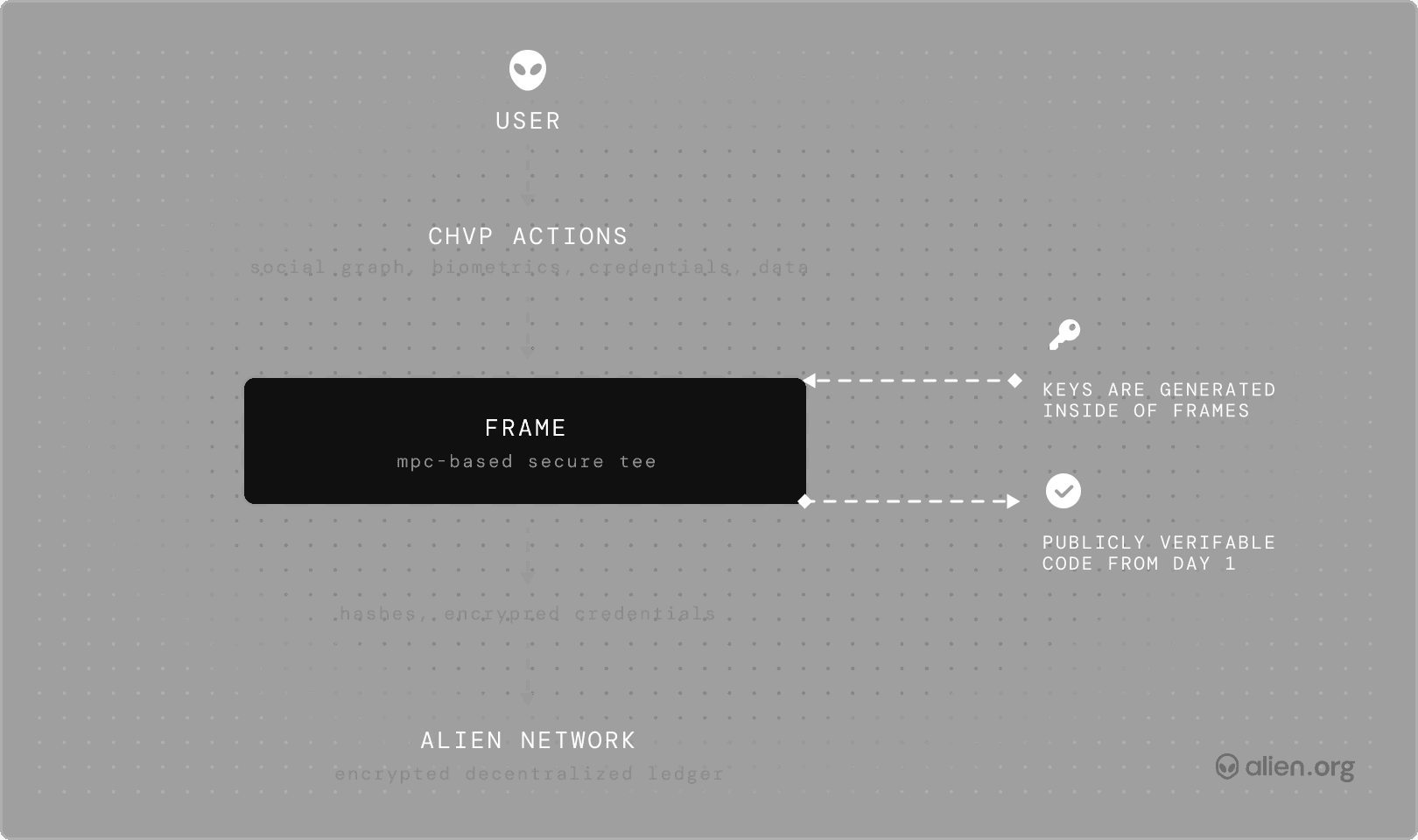
This is achieved through a combination of blockchain transparency and the Alien Network’s Frame architecture, which create a system that addresses the above needs in three key ways:
Users can verify the code running inside Frame and that their connection to Frame is encrypted.
Users can verify Frame’s TEE code is registered on-chain and signed by a trusted auditor.
Users can verify the code producing Frame’s TEE receipts and its blockchain registration.
Frame's TEEs handle the network's most sensitive operations: biometric face recognition and liveness detection; social graph and phone book processing; private transfers between users; verifying Sessions connected to Alien IDs; and seed phrase storage encrypted by a user’s PIN, for secure account recovery. This combination of transparency and privacy establishes the necessary trust model for equitable participation in the network. We will share more content in the coming months — including a whitepaper — that dives deeper into the technical details.
Fair Launch
Human uniqueness defines the Alien Network's architecture. Each user’s contributions give the network life and thus represent its fundamental value. This belief underlies the network’s currency, Aliencoin (ALN), which reflects the collective value of the network and is issued exclusively to users. Unlike traditional cryptocurrencies, where value can be concentrated through capital or mining power, Aliencoin's distribution model ensures that the network's value flows to the humans who create it.
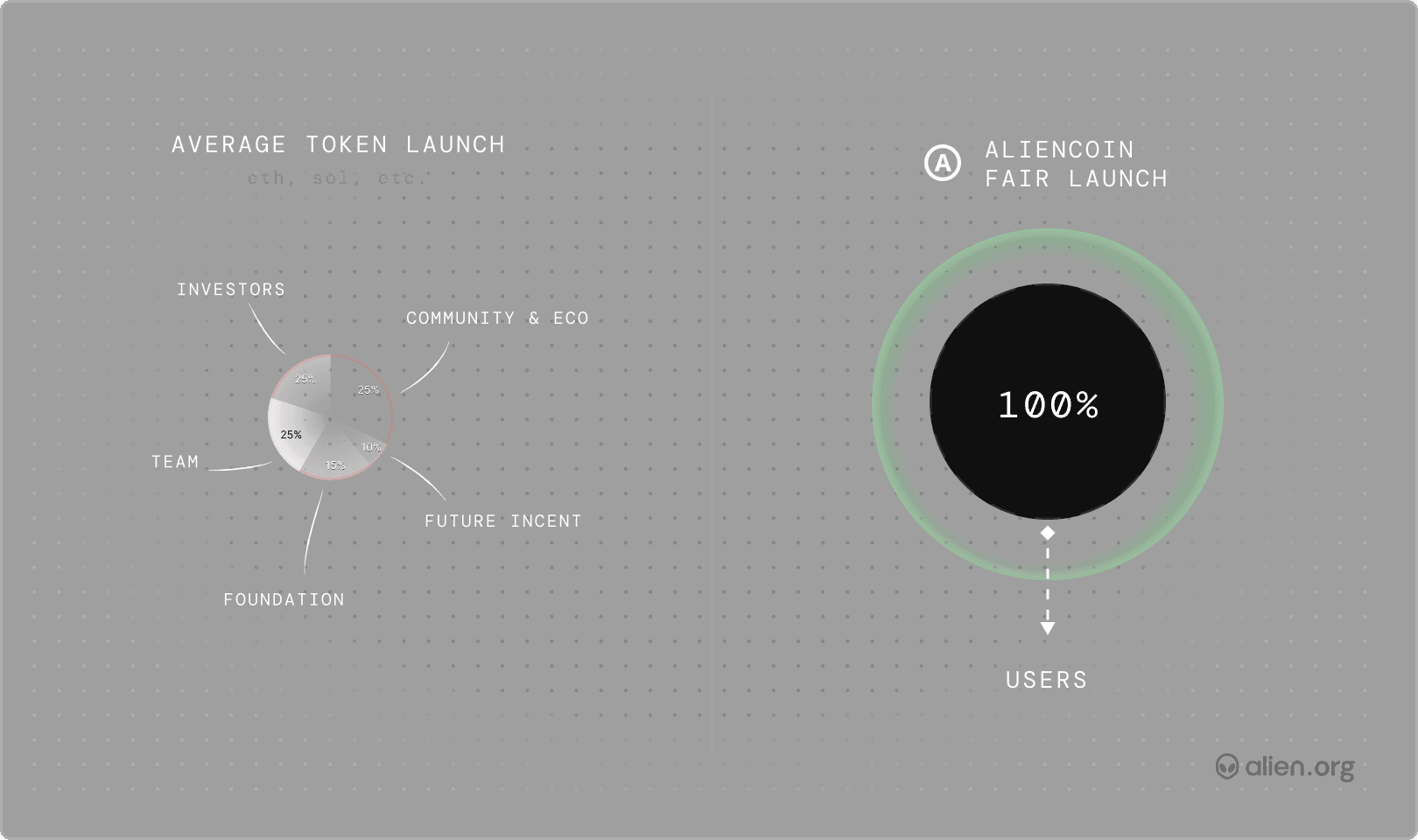
As each verified person represents irreplaceable value, Aliencoin leverages Metcalfe's Law, where a network's value grows exponentially with each new participant. Aliencoin will be launched with a fair distribution model: no pre-allocated coins for founders or investors, and no opportunities to pre-mine or purchase coins before mainnet launch. Once verified, each user receives equal allocations, with additional grants distributed as they engage with the network. This ensures Aliencoin functions as compensation for verification and participation.
Importantly, Aliencoin does not grant voting rights or governance power, and only verified humans can receive it — this excludes corporations, governments and unverified individuals from the coin’s distribution. The network’s design also incentivizes developers to build applications that serve user needs, ensuring the network prioritizes human-centric innovation rather than financial speculation.
Due to the fair launch model, Aliencoin's price will be determined organically by supply and demand. The Alien App team is building a peer-to-peer marketplace where, in the early phases of the network, users can propose their buy and sell prices. During the network's first 30 days, users can join a waitlist to sell Aliencoin. On day 31, the marketplace will launch and users from the waitlist will begin trading, with priority given to those who invite more participants. More information is available in Alien App.
Launch Phases
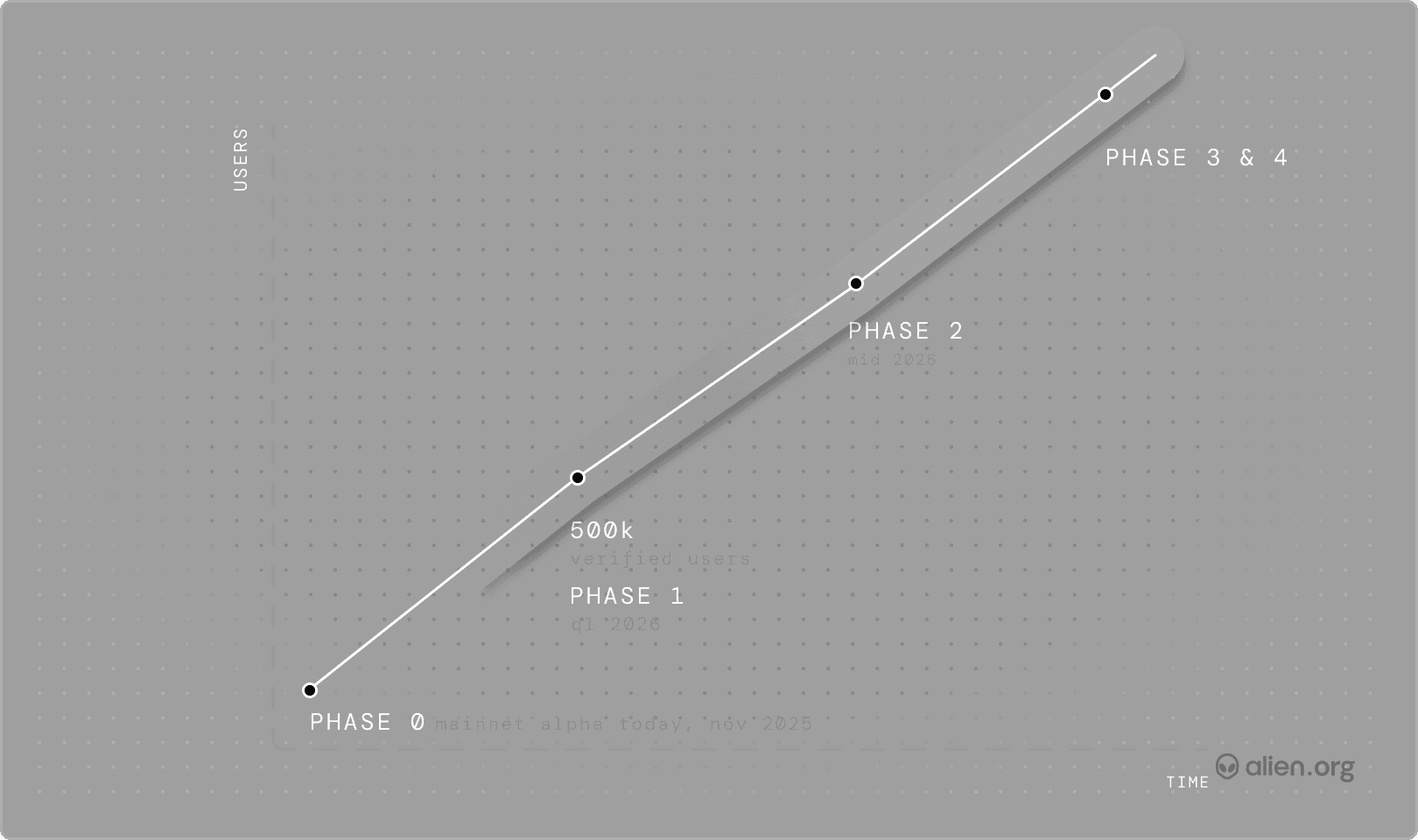
Due to Alien's unique identity verification requirements, we've decided to bypass a public testnet phase, launching directly as mainnet and rolling out the full functionality in phases. Unlike financial transactions that can be recreated on a new chain, identity verification produces contextual cryptographic proofs that must be checked against the existing user base to ensure uniqueness, making it impossible to transfer testnet verification to mainnet.
Phase 0 (Alpha) will support up to 500,000 users worldwide. These users will join using only biometric verification. During this initial phase, the network's nodes will be centralized, but all verification processes remain encrypted and secure. The network's trust model is established from day one, ensuring the Alien team cannot create fake users or access personal data. All verification processes will be recorded as cryptographic proofs within our Frame system, allowing anyone to independently audit that each user was uniquely verified.
Once Phase 0 reaches 500,000 users, Phase 1 begins. From this moment forward, invitations will become mandatory and new users must verify their birth date — which allows the system to create birth date groupings, improving facial recognition accuracy — and country-based social networks will be activated. The initial 500,000 users from Phase 0 will form the trusted foundation of the country-based networks, which will eventually merge into a single global network.
With each new phase, the network will introduce additional verification steps and reduce centralized oversight, transitioning to full decentralization during Phase 2. This step-by-step rollout ensures the network can securely scale the CHVP, building each layer on a foundation of previously verified users.
Timeline
Phase 0 launches today.
Phase 1 will begin early 2026.
Phase 2 will begin in mid 2026.
Information on Phase 3 and Phase 4 will be announced early next year.
Alien App
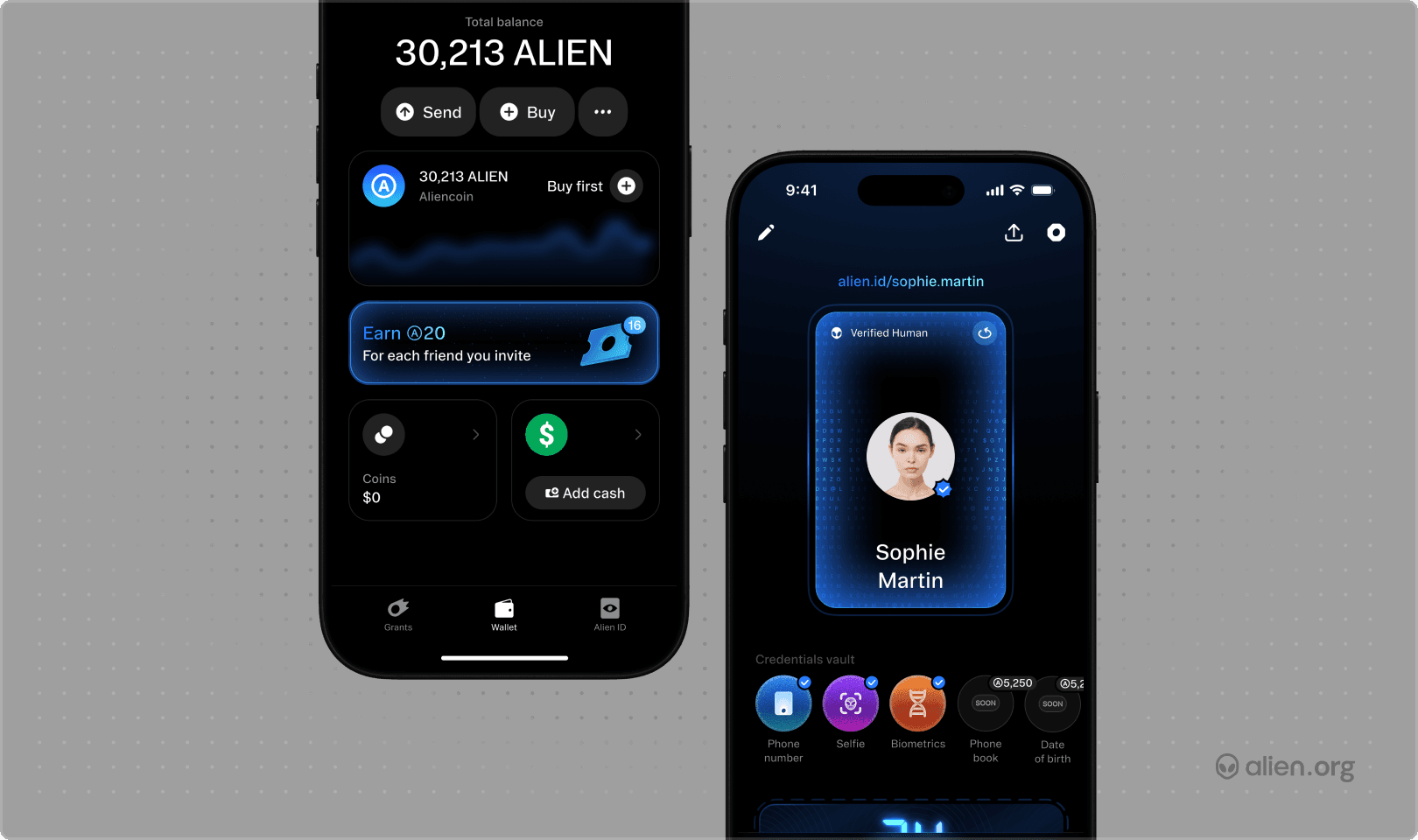
The Alien App is the first client application for the Alien Network. It is developed by Extraterrestrial Intelligence Co., a for-profit company operating independently from the non-profit foundation that will govern the Alien Network. Anyone can develop client applications for the network, with the Alien App as the initial reference implementation.
The Alien App serves as the primary interface for the Alien Network, giving users the ability to verify their identity through the CHVP, while also providing a secure environment for managing an Alien ID, credentials and Aliencoin. The app functions as a multi-chain wallet supporting both the Alien and Solana networks, and will support more networks soon. Through its intuitive interface, users can claim daily Aliencoin grants (as network participants), make global payments, authenticate their identity across the internet, and invite friends to join the network. The app also acts as an authentication interface for third-party applications through Alien ID SSO, enabling both web2 and Solana dApp developers to integrate identity verification into their platforms today.
You can download the Alien App now to become one of the first members of the Alien Network. You can also visit Alien on X for updates and Discord to join the community. Developers interested in integrating unique identity into their applications can explore the developer documentation for implementation guides, APIs and SDK resources.
If building trust in the age of AI feels urgent and important to you, consider joining us.

Founder of Alien
Writes about decentralized identity and proof of humanity
We raised $7.1M from Initialized, Finality and others. Read more